Friday, November 9, 2007

Bent's Old Fort Junior Ranger program.


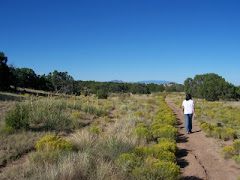
This weekend we visited Bent’s Old Fort, a national park in southern Colorado. Bent’s fort is an 1840’s trading post and it is made of adobe bricks. The fort is on the mountain branch of the Santa Fe Trail where traders, trappers, travelers, and Plains Indian tribes came together peacefully for trade.
The main trading was done with the Southern Cheyenne and Arapaho Indians for buffalo robes.
Bent's Old Fort national historic site is an outstanding destination for homeschooling families. The quality adobe reconstruction of an 1840s trading post on the Santa Fe trail is an example of what loving attention to detail can provide through living history. This isolated trading post, the Castle of the Plains, brought the Plains and Pueblo Indians, Mexicans, and Americans together for trade, and business, family, and political relationships developed that forever changed lives. Even the bookstore is of unusual quality, as it is stocked with many items accurate to the period, including powder horns, copper rum cups, shells, baskets, blankets, and hand-made leather pouches.
The Junior Ranger program at Bent's Old Fort is high-quality because instead of merely asking questions, the booklet elicits thought processes that put the kids in mind of the history that led to construction of the fort in the first place. For example, the first question is worded this way: "Imagine you are a trader out West in 1833 with Willam and Charles Bent and Ceran St. Vrain. You want to build a new trading post. Where can you place it so you can attract the most trade? How do you decide? Maybe you could look at a map and start drawing circles on it where you might want to build a trading post..." The booklet provides a map of the region and denotes rivers, the Trail, 1830s Mexico, Indian camps, buffalo herds, and beaver, and then leads the student to a logical conclusion about where to build the fort. This is one of the best parks we've visited, and that is really saying something, because the National Park Service Junior Ranger program is an underappreciated gem. For more photos, please visit our Santa Fe blog. For a look at our related stop at the Comanche National Grasslands, click here.


Tuesday, November 6, 2007

Santa Fe trail study and assignment.

You have to reach Santa Fe, New Mexico, so you are taking the unusual step of traveling with the traders and people of commerce on a wagon train. (No stagecoach.) You keep a diary (words and drawings) of your experiences.

What is a typical day like on the journey? Be as descriptive as possible and don't leave out the dangers you'll face. Include images and facts from Gregg’s Commerce of the Prairies. Why does riding the trail seem to have a “sanative” or healing effect on health problems?

Use/depict some of these words and phrases, and add your own:
wagon corral/hollow square (p. 43)
cholera
prairie
cache (p. 47)
dashboard
buffalo wallows
traders escorted only as far as Arkansas River (p. 19)
dressing for the prairie (p.33)
driver’s phrases: “Go! Catch up! All set!” (p. 35)
kitchenware (skillet, frying pan, campkettle, coffee pot, tin cup, butcher’s knife) (p. 39)
mirage
canteens
Cimarron River
caravan
oxen, mules or horses?
bustle in Santa Fe when caravan arrives (p. 80)

Since we'll be visiting Bent's Old Fort National Historic Site, include what you learn there in your diary.

Bent's Old Fort area map.


Pressure on the plains.

The Indian Removal Act of 1830.

Map: PBS.org

Sunday, November 4, 2007


When you're studying the heyday of the Santa Fe trail, riding lessons are a good idea. E., it turns out, is a natural.

Monday, October 29, 2007

The Santa Fe Trail.


A foray into 1830s-1850s western U.S. history leads us to a no-holds-barred study of the Santa Fe trail and life on the wagon trains. Here are the books we're reading. (We can already tell you that Commerce of the Prairies is a masterpiece of the genre.)
The trail ran between Missouri and New Mexico, opening in 1822-1823 after the first journey by trader William Becknell when the word spread of his success. About 780 miles long, the Santa Fe trail fell out of use in 1879, when the railroad reached (near) town. Much more to come!


The Santa Fe National Historical Trail bibliography (NPS) site provides a helpful list of resources.

Saturday, October 27, 2007

Post-war fiction and the Red Menace.


A good starting point for explaining post-war psychology and anthropology to our middle schooler this week was The Day the Earth Stood Still, one of those movies people often refer to (Klaatu barada nikto and all that) but rarely seem actually to watch. So we viewed the film as a family and discovered that its message (as well as its production design and cinematography) stand up as well in 2007 as it did when made in 1951.

This is the kind of sci-fi that uses a robot and spaceship to make a moral and political statement -- in this case, "This is one planet. Unite. Stop being fearful instead of reasonable. Stop all the chaotic destruction or you yourselves will be destroyed."
There are classic visual references, such as the spaceship becoming the public's point of reference in Washington...rather than the Washington Monument, which fades into the background. And there are also historical cultural references, such as the craziness that ensued after Orson Welles' War of the Worlds radio broadcast. It is EARLY sci-fi so there isn't a computer to be seen, not even on the spaceship.

Possible essay questions:

Explain the "Cold War" and how this film addresses the importance of learning to live peacefully in the nuclear age.

How might the film be seen as taking a survey of life in the United States in the 1950s?

Some people see the movie as a religious allegory, since Klaatu chooses to appear in human form, walk among humans, and adopts the name Mr. Carpenter. What other elements in the film might support such a reading? (We will examine other "alien messiahs" in science fiction cinema.)

Discuss The Day's story structure as a counterpoint to the science fiction of today, where special effects are preeminent and presenting a solid, well-told story has faded into the background. For instance, is there a climactic battle scene in The Day the Earth Stood Still? Why does the film's ending work, or not work, for you?

Robert Wise directed the film, and his astonishing body of work ranges from The Magnificent Ambersons to West Side Story to Run Silent Run Deep to The Sound of Music.

Movie music history: The Day was one of the first Hollywood films to include electronic instruments on its soundtrack. Why would Bernard Herrman have chosen this particular "sound" for his score? What moments of the film make particularly effective use of music to set the tone for the action? According to moviediva.com:

The memorable music was written by the brilliant, tempestuous Bernard Herrmann. He used 2 Theremins for the otherworldly sounds, one pitched high and one low. The Theremin was an early electronic instrument that had occasionally been used with great effect in film scores, notably in Miklos Rozsa's music for Hitchcock's Spellbound. Herrmann rounded out the unusual instrumentation with electric violin, bass and guitar, along with 4 pianos, 4 harps and an unorthodox collection of brass.

Thursday, October 25, 2007

Fifty minutes per day.


E. spends fifty minutes each day drawing from observation. We hope this will strengthen her drawing skillls, but it is also an excellent way to get centered and focused, for example before writing an essay.

Tuesday, October 23, 2007

"Growing up, I was weird. I was a bookworm."


In his first novel for young adults, bestselling author Sherman Alexie tells the story of Junior, a budding cartoonist growing up on the Spokane Indian Reservation. Tonight we had the chance to attend a reading by the author at the Indian Art Museum on the Plaza. He didn't do a reading in the traditional sense. Instead, he told stories based on the book.
Here are some of the highlights from Sherman Alexie's remarks in Santa Fe.
"Farm boys carry pigs around like they are already bacon."
"I'm an Indian, but when I go to NYC, I blend in and people think I'm half of whatever they are."
"We had only one Indian blanket. We needed Queer Eye for the Indigenous Guy."
When he went off-reservation to attend a private school, it was "the whitiest white place in the history of white places."
"When you're small, throw the first punch, because it might be your last chance."
"The res school was terrible. The only computer was a TRS 80 that I won in a raffle, and no one knew how to use it."
"I don't like to do appearances where I sit on panels with 'scholars,' guys in suits from Harvard and so on. I want to walk up to them [making a menacing gesture] and say, 'DECONSTRUCT THIS.'"
"At my school the white guys mixed up their knowledge of Indian names. 'Crazy Sitting Horse.' "
Here is an interview with the author from NPR.